
Recursos. Solo para los más curiosos#
Generación procedural#
Sebastian Lague Procedural Terrain Generation.
Catlike Coding Noise Derivatives, going with the flow.
t3ssel8r Giving Personality to Procedural Animations using Math.
Unity Creating a boss with procedural animation | Prototype Series.
How to Use the New Simulation Nodes in Blender 3.6 LTS.
The Procedural Animation of Gibbon: Beyond the Trees - Wolfire Games.
Nabil Mansour. Youtube channel.
FRACTAL GLIDE. Youtube playlist.
Fractal Ray Marching in Blender (Geometry Nodes). Youtube video.
Real-time diffusion in TouchDesigner - StreamdiffusionTD Setup + Install + Settings. Youtube video tutorial.
Rendering#
The Future of Rendering - Jules Urbach. Youtube video.
WebGPU#
Introducing WebGPU: Unlocking modern GPU access for JavaScript.
WebGPU Tutorial - Advanced Graphics on the Web Course
Muchos enlaces a cosas interesantes de Web GPU: Awesome WebGPU.
Unlock the Potential of AI and Immersive Web Applications with WebGPU.
What WebGPU Means to XR and Metaverse by Andrey Ivashentsev. Youtube video.
Generative Coding - The Nature of Code Ported to Three.js. Web page.
WebGPU Fluid Simulation. Web page.
WebGPU Fundamentals. Web page.
WebGPU Compute Shader Basics. Web page.
Web ML#
Switching from Unity to Wonderland Engine. Youtube video.
Getting Started with audio classification for web using MediaPipe Solutions. Youtube video.
Getting started with pose landmark detection for web using MediaPipe Solutions. Youtube video.
Getting started with text classification for web using MediaPipe Solutions. Youtube video.
Getting Started with face detection for web using MediaPipe Solutions. Youtube video.
Getting Started with face landmark detection for web using MediaPipe Solutions Youtube video.
Visual Blocks ML: Create AI demos faster using custom nodes for your favorite APIs. Youtube video.
WebXR#
WebXR App Wonderland Engine. Web page.
Mattercraft. The next generation of 3D web tooling. A brand new creative tool for building rich 3D experiences for the web, including AR, VR and WebXR. Web site.
WebXR in Mattercraft: Rapid AR/VR creation for Apple Vision Pro, Quest 3 & ML2. Youtube video.
Switching from Unity to Wonderland Engine. Youtube video.
WebXR API. Immersive Web. Web page.
How to use WebXR with Unity - January 2024 Edition. Youtube video.
The BEST 👑 PC Builds for VR Gaming in 2024! - Ft. Meta Quest 3. Youtube video.
Top 5 WebXR Frameworks - Comparison By Jonathan Haleon November 14, 2019. Web page.
State of Compute: Maximizing Performance on Meta Quest. Youtube video.
Reality Accelerator Toolkit. Github repo.
Spatial Web Template. Github repo.
Immersive Web Emulator. Github repo.
Project Flowerbed. An immersive WebXR gardening experience written on top of THREE.JS. Github repo.
Learn to Create WebXR, VR and AR, Experiences with Three.JS. Youtube playlist.
Rendering immersive web experiences with Three.JS and WebXR. Web site.
Spatial Fusion. Mixed rality experience. https://spatialfusion.io/
Tools#
n8n. Secure, AI-native workflow automation. Web site.
Cursos#
Blender: geometry nodes from scratch.
3D Computer Graphics Programming. Course.
p5.js shaders. Web site.
Chris courses. Web site.
HTML5 Canvas Tutorials for Beginners | Become a Canvas Pro. YouTube playlist.
JavaScript Audio CRASH COURSE For Beginners. YouTube playlist.
Design for Developers. Web site.
Introduction to Cables.gl and Javascript coding. Youtube playlist.
Artistas, diseñadores, studios#
Patrik Hübner. Generative design web site.
This is onformative. A studio for digital art and design. Web page.
Neri Oxman. Former Associate Professor of Media Arts and Sciences. Web page.
Design at the Intersection of Technology and Biology | Neri Oxman | TED Talks. Youtube video.
Andrey Ivashentsev. Web page.
Kishimisu Creative Developer. Web page.
Nabil Mansour. Cone marching project. Web page.
Bileam Tschepe. Berlin based artist and educator creating audio-reactive, interactive and organic digital artworks, systems and installations with TouchDesigner and artificial intelligence, collaborating with and teaching people worldwide. Web site.
Robert Hodgin. He is a co-creator of the Cinder C++ framework. Web page.
Sila Sveta. Web site.
Steve’s makerspace. With lot of resources. Web Page.
Brand new school. Web site.
I’m Joshua, an Interaction Designer. Web site.
Libros#
Generative Design: Visualize, Program, and Create with JavaScript in p5.js.
Generative Design. Book.
SDL Game Development. Book.
Math#
Math For Video Games: The Fastest Way To Get Smarter At Math.
This equation will change how you see the world (the logistic map).
Numerical Simulation of Ordinary Differential Equations: Integrating ODEs.
Animaciones basadas en el video Chaos Equations - Simple Mathematical Art by CodeParade usando blender + animation nodes beauty of math.
Computational growth process. Youtube video.
Wanderers. Christoph Bader, Dominik Kolb, William Patrick, Steven Keating, Sunanda Sharma, Prof. Neri Oxman. Web site.
Física#
Sitios#
A community maintained Python library for creating mathematical animations.
Tutoriales cortos de la profesora Penny de Byl sobre el manejo de tiempo, velocidad, aceleración y cálculo de trayectorias.
Videos#
3Blue1Brown Differential equations, a tourist’s guide.
How to Set Up Dynamic Water Physics and Boat Movement in Unity | Ship Buoyancy Tutorial.
Craig Taylor—Outlier 2021—3d Geo Data Viz: From Insight to Data Art.
Learn how to use a geometry feedback loop to create a differential growth animation in Blender 3.3!.
Beautiful graphics from the chaos theory created by sali-math-arts.
Lorenz System: Visualization by Ross Mentor Dr. Bruce Stewart.
Lorenz Attractor Visualization - Simulation of Chaos a.k.a Butterfly Effect.
Attraktor Designer - Liu Chen Attraktor Variations - Made with TouchDesigner.
Unity Fluid Mechanics: Simulating Tank Fluid Height During Drainage.
Blender Tutorial: Geometry Nodes Simulation: Advect by Curl Noise.
Math meets artistry | Animation | Computer animation | Khan Academy.
Math for Game Programmers: Fast and Funky 1D Nonlinear Transformations.
Neri Oxman: Biology, Art, and Science of Design & Engineering with Nature | Lex Fridman Podcast #394. Youtube video.
Bio-Inspired Design | Neri Oxman. Youtube video.
Optimización#
Portafolios#
Video references#
In My Room (Audio) - Jacob Collier.
20 Best Music Videos that Story Tell -Narrative Music Video.
Jacob Collier - Never Gonna Be Alone (feat. Lizzy McAlpine & John Mayer) [Official Music Video].
SIAMÉS «Mr. FEAR» [Official Animated Music Video].
Audioreactive Video Playhead - [TouchDesigner].
Touchdesigner Audioreactive Visualizer for Jeffrey Earl Kinart’s song «Ridiculous».
INCREDIBLE ARTISTIC MUSICVIDEOS.
Music Visualizer - 3D audio spectrum visualizer made with Unity3D.
AI Manifest: The Most Beautiful Space Visualization on the Internet.
Tool - Vicarious Documentary (2007). Youtube video.
Audio#
StoryTelling#
DS-Fusion: Artistic Typography via Discriminated and Stylized Diffusion.
How to talk to white kids about racism. Web site.
Thrends#
Top 2024 Web Design Trends. YouTube video.
Papers#
Advanced Character Physics. Thomas Jakobsen.
StreamDiffusion: A Pipeline-level Solution for Real-time Interactive Generation. Web site.
Data Viz#
The Art of Data Visualization | Off Book | PBS Digital Studios
Games#
Fractal Glide. Steam game.
Noita. Steam game.
Exploring the Tech and Design of Noita. Youtube video.
Recreating Noita’s Sand Simulation in C and OpenGL | Game Engineering. Youtube video.
sandspiel. Game with pixels. Web site.
Making a falling sand simulator. Web site.
p5.js#
Physical computing course de Makeability Lab.
Correr localmente (y depurar) aplicaciones usando el Live Server de visual studio code.
Tutorial de depuración de aplicaciones con Microsoft Edge.
SDF#
Volumetrics: Introduction to ray marching | Tutorial. Youtube video.
Ray Marching, and making 3D Worlds with Math. Youtube video.
Coding Adventure: Ray Marching. Youtube video.
Ray Marching Project. Github repo.
Distance functions. Web page.
Ray Marching and Signed Distance Functions. Youtube videos.
From Raymarching to Conemarching - Devlog 1. Youtube video.
3D Audio Visualizer. Web page.
My journey into fractals. Gregory Ivanov. Blog.
Syntopia. Generative Art, 3D Fractals, Creative Computing. Web page.
Cone marching. Seven/Fulcrum. pdf.
Ray Marching for Dummies. Youtube video.
Ray Marching Simple Shapes. Youtube video.
Ray Marching playlist. Youtube playlist.
p5.js Ray Marching. p5.js editor.
Live#
Virtual production#
Physical computing simulation#
Creative Coding#
Where there is data, there is design. Unlocking the potential of generative design and creative coding. Web page.
Creative Coding = unexplored territories | Tim Rodenbröker | TEDxUniPaderborn. Youtube video.
Tim Rodenbroeker site. Web page.
Creative Coding as a School of Thought. Web page.
public class Graphic_Design implements. An investigation towards bespoke Creative Coding programming courses in graphic design education. Web page.
What is Creative Coding? Web page.
A Cretive Coding Method. New stories. Future aesthetics. Generative design for brands. Web page.
Unity#
Introduction to the Universal Render Pipeline for advanced Unity creators. Web site.
Introduction to the Universal Render Pipeline for advanced Unity creators. Book.
The Universal Render Pipeline Cookbook. Book.
Level up your programming with game programming patterns. Web site.
Simplified Clean Architecture Design Pattern for Unity. Web Page.
Simple Clean Architecture. Web page.
A quick intro to Dependency Injection: what it is, and when to use it. Web page.
Book Download: Dependency Injection with Unity. Web page.
This is an example project of Unity GameEngine to explain the concept of «Simple Clean Architecture». Github repo.
Simple Clean Architecture Example for Unity without third party libraries. Github repo.
5 Things to Know About Reactive Programming. Web site.
The Reactive Manifesto. Web site.
Software Architecture in Unity. Youtube video.
The Clean Code Blog. Web page.
Can you make SUCCESSFUL games with DIRTY CODE? Youtube video.
Learn Unity Beginner/Intermediate 2023 (FREE COMPLETE Course - Unity Tutorial). Youtube video.
Base defender clips. Youtube playlist.
Clean Architecture en español. Youtube playlist.
The secret to how to make your game look good in Unity | all you need to know about post processing. Youtube video.
Level_up_your_code_with_Game_Programming_Pattern. Ebook de Unity.
Game Programming Patterns Tutorials. Youtube playlist.
Web libraries#
Design#
Resilient Web Design by Jeremy Keith. Web site.
Design for developers by Mmdn Curriculum. Web site.
The latest in Material Design Google IO 2024. Youtube video.
Immersive web experiences#
Interactive Web experiences#
Incredibox. Music interactive experience. Web site.
Chrome music experiments. Web site.
Visualizing Music with p5.js. Web site <https://therewasaguy.github.io/p5-music-viz/>.
Cursos de cables.gl. Youtube channel.
Lights and Shadows Operators - getting started - Video Tutorial. Youtube video.
Mobile controlled visualization with Cables.gl. Algunos operadores están desactualizados. Youtube tutorial.
Blender#
Math x Blender = POWER! Youtube tutorial.
How to Simulate a 100.000+ Fish Swarm in Blender! Youtube tutorial.
Geometry Nodes Tutorials. Youtube playlist.
The Big Nodebook: A Geometry Nodes Guide. Web site.
TED Talks#
Ejemplos#
Borrar del historial de git un archivo#
A veces cuando estás trabajando con git te ocurre que por error incluyes en el historial del repositorio un archivo o un directorio grande. Cuando eso te pasa es muy posible que te des cuenta luego de un rato y borres de tu proyecto el archivo o directorio; sin embargo, cada que clonas el repositorio en otro computador notas que el repositorio sigue siendo muy grande. Lo que pasa es que el archivo o directorio aún está en el historial de git como un backup porque git no sabe que lo incluiste por equivocación y más bien te deja abierta la puerta para que lo recuperes en caso de necesitarlo. Incluso en Github puede ver el historial de tu repositorio. Si vas a un commit antiguo podrás ver que el archivo o directorio eliminado de tu versión más reciente del proyecto aún sigue en el repo. Entonces ¿Qué puedes hacer para eliminar del historial ese archivo o directorio para que no te aparezca en ninguno de los commits de la historia de tu proyecto? Sigue estos pasos:
Clona el repositorio en tu computador
Cámbiate al directorio de tu repositorio. Si ejecutas el comando ls -al podrás ver que allí está el directorio .git.
Ejecuta el comando:
git filter-branch -f --index-filter "git rm -rf --cache --ignore-unmatch path_al directorio" HEAD
Si de casualidad en el path tienes espacios o caracteres como ñ, tildes, paréntesis, entre otros, debes marcarlos. Por ejemplo, supón que quieres borrar del historial la carpeta Library que está en el directorio
My project (1), entones cuando escribas el path debes especificar esta carpeta comoMy\ project\ \(1\). Nota que tanto los espacios como los paréntesis en el nombre del directorio deben marcarse usando el carácter\. Te dejo un ejemplo:git filter-branch -f --index-filter "git rm -rf --cache --ignore-unmatch 01ruido/My\ project\ \(1\)/Library" HEAD
Una vez la operación sea exitosa, debes enviar el repositorio local a Github, pero necesitarás forzar esta operación:
git push --force origin main
Por último, si todo sale bien podrás borrar el backup que hace git:
rm -r -f refs/original/
Rutas largas en Windows#
Windows mantiene una limitación de tamaña de ruta de 260 caracteres. Esta limitación
se presenta para mantener la compatibilidad con versiones antiguas del sistema
operativo; sin embargo, esta limitación puede ser muy incómoda. Incluso a veces
es necesario que crees tus proyectos en la raiz del volumen de tu sistema de archivos,
por ejemplo, en la unidad C:. Afortunadamente, esta limitación se puede levantar.
Para ello tendrás que crear una clave nueva en el registro de windows. Primero vas a
verificar si la clave ya existe. Abre PowerShell y ejecuta:
Get-ItemProperty -Path "HKLM:\SYSTEM\CurrentControlSet\Control\FileSystem"
Busca si la clave LongPathsEnabled existe y si su valor es 1. Se es así, ya tienes
levantada la restricción. Si no es así, entonces tendrás que escribir el registro de
windws para crear la clave y hacerla igual a 1:
New-ItemProperty -Path "HKLM:\SYSTEM\CurrentControlSet\Control\FileSystem" -Name "LongPathsEnabled" -Value 1 -PropertyType DWORD -Force
Advertencia
AGUANDO LA FIESTA
Ten presente que necestarás permisos de Administrador para hacer esta operación.
TDAxis#
Crea y transforma imágenes y sonidos con los movimientos de tu cuerpo aquí.
Hydraulic Erosion#
Aquí está el ejemplo.
Experimentos con audio#
En esta guía podrás realizar algunos experimentos con audio.
Atractor de Lorentz#
La siguiente figura (tomada de aquí) corresponde a un atractor de Lorenz que es un conjunto de soluciones caóticas de un sistema de Lorenz.
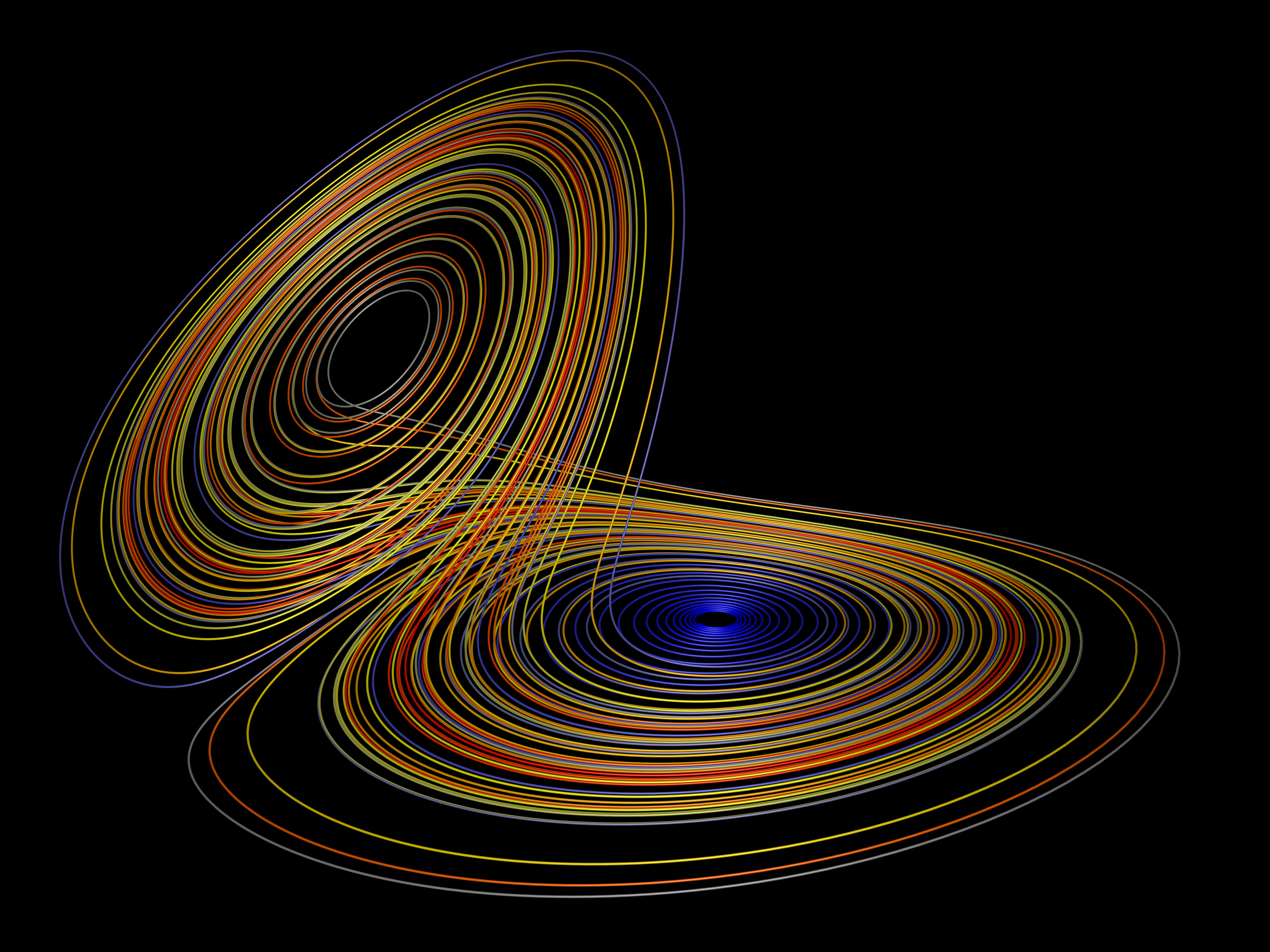
Atractor de Lorenz#
Primero quiero que veas este video.
Ahora escucha el tema con una animación construida en Unity utilizando un atractor de Lorenz.
Te dejo una parte del código para que veas que no está compleja la cosa.
void Update()
{

    AudioListener.GetSpectrumData(spectrum, channelSelect, FFTWindow.Hanning);
    channelAvg = spectrum.Average();

    // cycle color over time
    sColor.H = hue;
    eColor.H= hue;
    line.startColor = sColor.ToColor();
    line.endColor = eColor.ToColor();
    line.startWidth = lineWidth * channelAvg * 1000;
    line.endWidth = lineWidth * channelAvg * 1000;
    hue += Time.deltaTime * oneOverColorCycleTime;
    //cycling the hue over time
    hue = hue % 1;

    float x0, y0, z0, x1, y1, z1;
    x0 = startX;
    y0 = 0;
    z0 = 0;
    float sigmaMod = sigma * channelAvg * 1000;

    for (int i = 0; i < iterations; i++)
    {
        x1 = x0 + h * sigmaMod * (y0 - x0);
        y1 = y0 + h * (x0 * (rho - z0) - y0);
        z1 = z0 + h * (x0 * y0 - beta * z0);
        x0 = x1;
        y0 = y1;
        z0 = z1;
        line.SetPosition(i, transform.position + new Vector3(x0, y0, z0));
    }
}
Exploración arduino-Blender#
Este es un experimento en construcción que busca conectar de algunas manera información del mundo físico con una simulación en Blender. Aún no hay resultados, solo estoy recolectando referencias e ideas.
Arduino Basic Blender to Arduino Communication. Youtube tutorial.
Math x Blender = POWER! Youtube tutorial.
¿Qué es la programación creativa?#
Tomado de este sitio:
Creative Coding is a process, based on exploration, iteration, reflection and discovery, where code is used as the primary medium to create a wide range of media artifacts.
MARK MITCHELL, OLIVER C. BOWN: TOWARDS A CREATIVITY SUPPORT TOOL IN PROCESSING. UNDERSTANDING THE NEEDS OF CREATIVE CODERS. ACM PRESS 2013, PAGE 143–146, CITED ACCORDING TO: STIG MØLLER HANSEN: PUBLIC CLASS GRAPHIC_DESIGN IMPLEMENTS CODE {//YES, BUT HOW?}: AN INVESTIGATION TOWARDS BESPOKE CREATIVE CODING PROGRAMMING COURSES IN GRAPHIC DESIGN EDUCATION, AARHUS 2019, PAGE 13. LINK
Según ChatGPT plus (septiembre 20 de 2023):
Creative coding refers to the use of computer programming as a means to produce artistic outputs. It’s a form of digital art where the emphasis is on the creative process and exploration, rather than just creating functional software. Creative coding often involves the generation of visuals, sound, animation, physical computing, and interactivity.
Dos herramientas para explorar:
p5.js - A JavaScript library that has its roots in Processing. It’s designed to make coding accessible for artists, designers, educators, and beginners.
TouchDesigner - A node-based visual programming language primarily used for real-time interactive multimedia content.
The creative coding community often participates in «live coding» events, where artists code in real-time to produce visuals and/or music, usually in front of an audience. These performances showcase the artistic and improvisational aspects of programming.
In essence, creative coding is about bridging the gap between art and technology, allowing artists to harness the power of computation in their artistic pursuits.
There’s a significant relationship between generative content generation and creative coding. In fact, generative methods are often a cornerstone of many creative coding projects. Here’s a breakdown of the relationship:
Definition of Generative Content Generation:
This refers to the automated creation of content (like images, music, stories, or patterns) based on a set of predefined rules, algorithms, or stochastic processes. The key principle behind generative content is that the output is not directly authored by a human, but rather is produced by a system designed by a human. The same generative system can produce a wide variety of different outputs, often surprising even its creator.
Creative Coding and Generative Content:
Many creative coding projects involve building systems that produce generative content. The creativity comes into play when designing the algorithms or rules that drive the generation. For instance, a creative coder might design an algorithm that simulates the growth of plants to generate digital artwork that looks like a forest.
Applications:
Visual Arts: Patterns, fractals, and generative adversarial networks (GANs) might be used to create unique pieces of artwork.
Music: Algorithms can be designed to produce melodies, rhythms, or entire compositions.
Interactive Installations: Creative coding can be used to create installations where the output (visuals, sounds) evolves based on user interaction or other inputs.
Animation and Motion Graphics: Generative methods can produce fluid, organic, or abstract animations.
Design: Patterns for textiles, wallpapers, or graphical elements can be algorithmically generated.
Live Coding: In live coding performances, artists often employ generative methods. The code they write in real-time sets up systems and processes that generate music or visuals, adding an element of unpredictability and spontaneity to the performance.
Exploration and Serendipity: One of the joys of generative content in creative coding is the sense of exploration. Since the output is determined by algorithms and sometimes random processes, even the creator may be surprised by the results. This serendipity can lead to delightful and unexpected artistic outcomes.
In summary, generative content generation is a major facet of creative coding. By designing systems and algorithms, creative coders can produce a vast array of unique and unpredictable artistic outputs.